
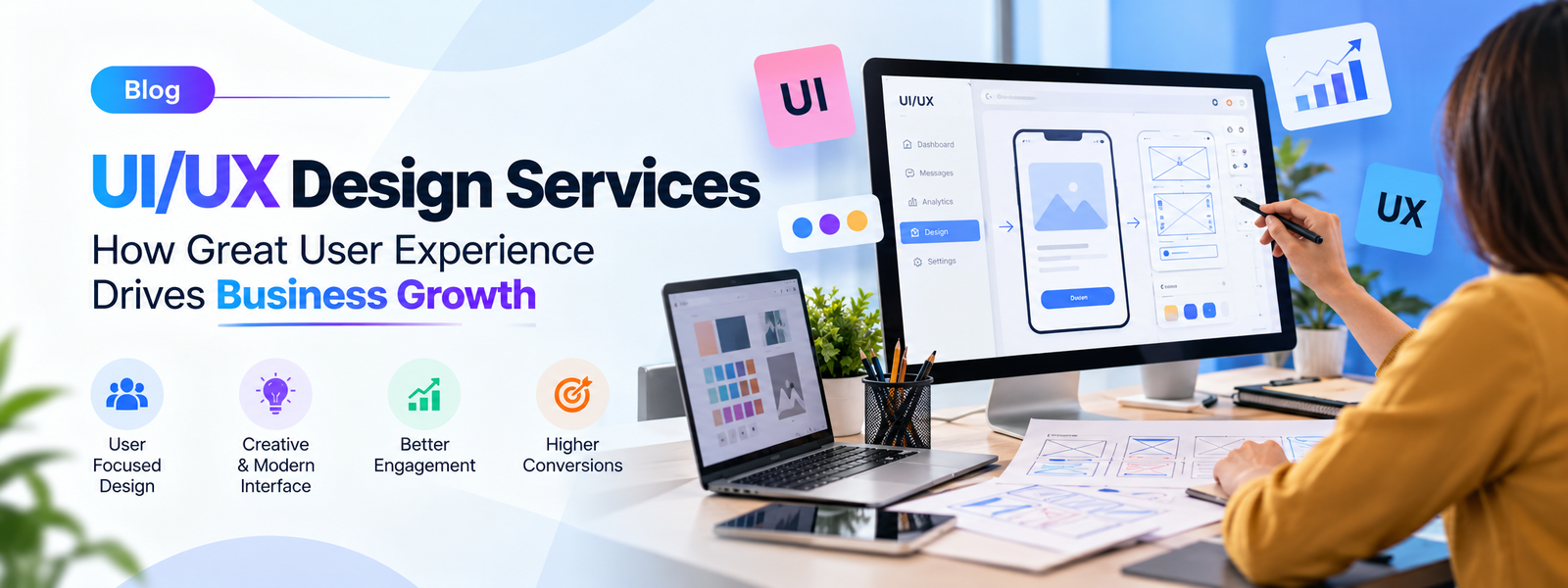
UI/UX Design Services: How Great User Experience Drives Business Growth
In today’s digital-first world, having a website or mobile application is not enough. Businesses need digital experiences that are easy to use, visually appealing, fast, intuitive, and designed around the needs of their users.
This is where UI/UX design plays an important role.
A well-designed user interface can create a strong first impression, while a well-planned user experience helps visitors find information, complete actions, and interact with a digital product without confusion. Together, UI and UX design can influence engagement, customer satisfaction, brand perception, and business conversions.
For businesses planning to build or improve a website, mobile application, SaaS product, eCommerce platform, or business software, investing in professional UI/UX design can provide a significant competitive advantage.
What Is UI/UX Design?
UI/UX is a combination of two closely related disciplines: User Interface (UI) design and User Experience (UX) design.
User Interface (UI) Design
UI design focuses on how a digital product looks and how users visually interact with it.
It includes elements such as:
- Colors and typography
- Buttons and forms
- Icons and illustrations
- Navigation menus
- Layouts and spacing
- Images and visual components
- Responsive design
- Interactive elements
The goal of UI design is to create an attractive, consistent, and easy-to-understand interface.
User Experience (UX) Design
UX design focuses on how users experience and interact with a website, application, or digital product.
It considers questions such as:
- Can users easily find what they need?
- Is the navigation simple?
- How many steps are required to complete an action?
- Where might users become confused?
- Is the website easy to use on mobile devices?
- Does the product solve the user’s actual problem?
In simple terms, UI focuses more on how a product looks, while UX focuses on how it works and feels.
Why Is UI/UX Design Important for Businesses?
A website or application often becomes the first major interaction a customer has with a business. If that experience is confusing, slow, or difficult to navigate, users may leave before completing their intended action.
A thoughtful UI/UX strategy can help businesses:
1. Create a Strong First Impression
Users can quickly form an opinion about a digital product. A clean, professional, and consistent interface can help establish trust and communicate the quality of a brand.
2. Improve Usability
Good UX removes unnecessary complexity. Users should be able to understand the interface and complete important tasks without needing instructions.
3. Increase User Engagement
Intuitive navigation, meaningful interactions, and relevant content can encourage users to spend more time exploring a website or application.
4. Improve Conversion Opportunities
Whether the goal is generating leads, receiving enquiries, selling products, booking services, or encouraging registrations, a well-designed user journey can make important conversion actions easier.
5. Build Brand Consistency
A consistent design system across websites, mobile apps, dashboards, and other digital products creates a recognizable brand experience.
6. Reduce Development Problems
UX planning, wireframes, and prototypes allow teams to identify usability problems before development. This can reduce unnecessary design and development changes later.
Key Elements of Effective UI/UX Design
Professional UI/UX design is more than choosing attractive colors and fonts. It combines research, strategy, structure, visual design, interaction design, and testing.
User Research
Before designing a product, it is important to understand the target audience.
Research can help identify:
- User needs
- Pain points
- Expectations
- Behaviour patterns
- Device preferences
- Common problems
- Purchase or decision-making behaviour
This information helps designers create experiences based on real user requirements rather than assumptions.
Information Architecture
Information architecture determines how content and functionality are organized.
A well-structured website should make it easy for users to understand:
- Where they are
- What information is available
- Where they should go next
- How they can return to previous sections
Clear information architecture is especially important for large websites, eCommerce platforms, portals, and business applications.
Wireframing
Wireframes provide a basic visual structure for a page or application screen.
They help define:
- Content placement
- Navigation
- Page hierarchy
- Calls to action
- Forms
- Functional areas
Wireframes allow teams to validate the structure before investing significant time in detailed visual design.
Prototyping
A prototype provides an interactive representation of the product.
Users and stakeholders can interact with important screens and flows before development begins. This helps identify usability issues and refine the experience at an early stage.
Visual UI Design
After the structure and experience are established, designers develop the visual interface.
This can include:
- Color systems
- Typography
- Buttons
- Cards
- Forms
- Icons
- Illustrations
- Components
- Spacing systems
- Responsive layouts
Usability Testing
Testing helps determine whether users can complete important tasks efficiently.
Design teams can observe where users experience difficulty and make improvements before the final product is launched.
UI/UX Design for Websites
A business website should do more than display information. It should guide visitors toward meaningful actions.
Depending on the business, these actions may include:
- Requesting a quotation
- Calling the company
- Sending an enquiry
- Booking a meeting
- Purchasing a product
- Registering for an account
- Downloading information
- Contacting support
A strong website UX connects the user’s needs with the business objectives.
For example, an industrial company may prioritize product discovery and quotation requests, while an eCommerce business may focus on product search, filtering, checkout, and payment.
UI/UX Design for Mobile Applications
Mobile users interact with applications differently from desktop users.
Mobile UX needs to consider:
- Smaller screen sizes
- Touch interactions
- Thumb-friendly controls
- Simple navigation
- Loading performance
- Mobile-first layouts
- Notifications
- Accessibility
- Different device sizes
A mobile application should make important actions easy to discover and complete with minimal friction.
UI/UX Design for eCommerce Websites
For eCommerce businesses, UX can directly influence the shopping journey.
Important areas include:
- Product discovery
- Search functionality
- Filters
- Product pages
- Product images
- Product comparisons
- Cart experience
- Checkout
- Payment flow
- Order tracking
A complicated checkout process can create unnecessary friction. A well-designed purchasing journey can make it easier for customers to move from product discovery to purchase.
UI/UX Design for SaaS and Business Applications
SaaS platforms and business applications often contain complex functionality.
Examples include:
- Admin dashboards
- CRM systems
- Project management software
- HR platforms
- Financial applications
- Analytics dashboards
- Customer portals
For these products, UX design should focus on information hierarchy, workflows, permissions, data visualization, and task efficiency.
The goal is not simply to make the dashboard attractive. The interface should help users understand information and complete their work efficiently.
Common UI/UX Design Mistakes
Even visually attractive websites and applications can provide poor experiences if fundamental UX principles are ignored.
Some common mistakes include:
Too Much Information
Overloading users with content and visual elements can make interfaces difficult to understand.
Complicated Navigation
Users should not have to search through multiple menus to find important information.
Poor Mobile Experience
A website that works well on desktop but becomes difficult to use on mobile can lose a significant portion of its audience.
Inconsistent Design
Different button styles, typography, spacing, and navigation patterns can make a product feel confusing and unprofessional.
Weak Calls to Action
Users should understand what action they can take next.
Ignoring Accessibility
Design should consider users with different abilities and interaction requirements.
Designing Without User Research
Designing entirely from assumptions can result in a product that looks good but does not solve the user’s actual problem.
The UI/UX Design Process
A professional UI/UX project generally follows a structured process.
Step 1: Requirement Analysis
The team understands the business objectives, target users, product requirements, competitors, and project scope.
Step 2: User Research
Research is conducted to understand user needs, behaviours, expectations, and pain points.
Step 3: Information Architecture
The content, features, navigation, and user journeys are organized.
Step 4: Wireframing
The basic structure of pages and screens is created.
Step 5: Prototyping
Interactive flows are developed to demonstrate how users will move through the product.
Step 6: UI Design
The visual design system and final interface are developed.
Step 7: Usability Testing
The design is evaluated with users or stakeholders to identify potential issues.
Step 8: Design Handoff
Final designs, components, specifications, and assets are prepared for the development team.
Step 9: Continuous Improvement
After launch, user feedback and analytics can be used to identify opportunities for further UX improvements.
How UI/UX Design Can Improve Business Performance
UI/UX should ultimately support business objectives.
Depending on the product, better UX can contribute to:
- Higher engagement
- Better customer satisfaction
- More enquiries
- Improved lead generation
- Better product discovery
- Higher checkout completion
- Lower user frustration
- Stronger brand perception
- Improved customer retention
However, UI/UX is not a one-time activity. Digital products should continuously evolve based on user behaviour, business goals, technology, and market changes.
How to Choose a UI/UX Design Company
When selecting a UI/UX design partner, businesses should look beyond attractive portfolio images.
Consider factors such as:
Portfolio
Review relevant website, mobile app, SaaS, dashboard, or eCommerce projects.
Design Process
Ask how the company handles research, wireframing, prototyping, testing, and design handoff.
Industry Understanding
A good design team should understand your business model, audience, competitors, and conversion objectives.
Responsive Design
Make sure the design approach considers desktop, tablet, and mobile experiences.
Collaboration
UI/UX design often requires close communication between business owners, designers, developers, and marketing teams.
Development Understanding
Designs should be practical to implement. A team with an understanding of frontend development can create designs that balance aesthetics, usability, and technical feasibility.
Why Businesses Choose Whiz Technology for UI/UX Design
At Whiz Technology, UI/UX design is approached with a combination of user experience, visual design, business objectives, and technology.
The objective is not simply to create attractive screens. The focus is on creating digital experiences that are intuitive, responsive, scalable, and aligned with business goals.
UI/UX design can be applied across different digital products, including:
- Business websites
- Corporate websites
- eCommerce platforms
- Mobile applications
- SaaS products
- Web applications
- Admin dashboards
- Customer portals
- Digital platforms
From initial user flows and wireframes to high-fidelity interfaces and development-ready designs, a structured approach can help turn business requirements into practical digital experiences.
Frequently Asked Questions
What is the difference between UI and UX design?
UI design focuses primarily on the visual interface and interactive elements, while UX design focuses on the overall user journey, usability, structure, and interaction with the product.
Is UI/UX design important for a business website?
Yes. A good UI/UX experience can make navigation easier, improve engagement, strengthen brand perception, and guide visitors toward important actions.
Is UI/UX design only for mobile apps?
No. UI/UX principles are used for websites, mobile applications, SaaS platforms, dashboards, eCommerce stores, portals, and many other digital products.
What does a UI/UX designer do?
A UI/UX designer researches user needs, plans information architecture and user journeys, creates wireframes and prototypes, designs interfaces, and helps improve usability.
How long does a UI/UX design project take?
The timeline depends on the complexity of the product, number of screens, research requirements, functionality, revisions, and project scope.
Can UI/UX design improve conversions?
Yes. A well-planned user journey can reduce friction and make important actions such as enquiries, registrations, purchases, bookings, and sign-ups easier to complete.
Conclusion
A successful digital product needs more than attractive visuals. It needs a clear structure, intuitive navigation, meaningful interactions, responsive design, and a deep understanding of its users.
Professional UI/UX design brings these elements together to create digital experiences that are easier to use and better aligned with business objectives.
Whether you are launching a new website, redesigning an existing platform, developing a mobile application, or building a SaaS product, investing in UX from the beginning can help create a stronger digital experience.
Whiz Technology helps businesses transform ideas and requirements into user-focused digital experiences designed for usability, engagement, and business growth.
If you are planning a new website, mobile application, SaaS platform, or digital product, a well-planned UI/UX strategy can be the foundation for a better customer experience.


LET'S BUILD YOUR DIGITAL GROWTH
Discuss Your Project
→
Need Professional Digital Solutions?
Connect with Whiz Technology for website development, digital marketing, AI automation and business solutions.