

Content SEO Strategy
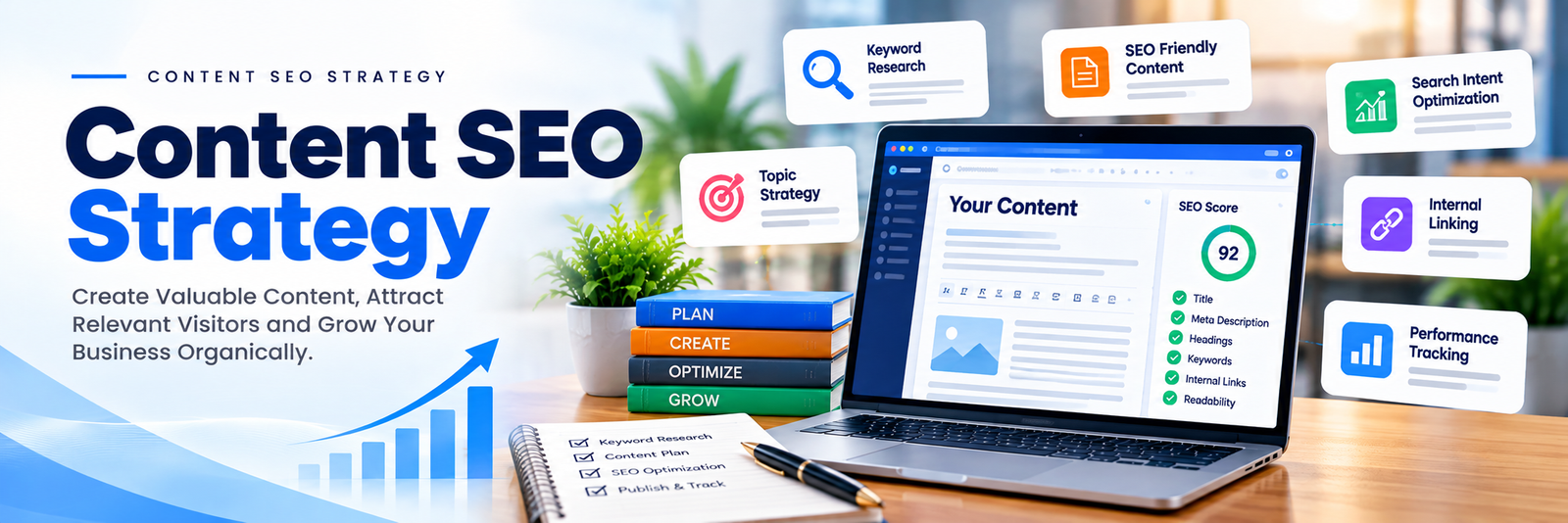
Content SEO Strategy: A Complete Guide to Growing Organic Traffic
High-quality content plays an important role in helping businesses reach their target audience through search engines. However, publishing blog posts alone is not enough. Your content needs a clear SEO strategy, relevant topics, useful information and a structure that helps readers find answers to their questions.
A well-planned content SEO strategy connects your business goals with the information your audience is searching for. It helps you create relevant website pages, blog articles and resources that can attract visitors and support business growth.
At Whiz Technology, we help businesses strengthen their online presence through content optimization, keyword research, SEO-friendly content planning and strategic internal linking.
In this guide, you will learn what content SEO is, why it matters and how to develop a practical strategy for your website.
What Is Content SEO?
Content SEO is the process of planning, creating, optimizing and improving website content to make it useful for people and relevant to search engine queries.
It combines keyword research, search intent analysis, content quality, on-page optimization, internal linking and ongoing performance measurement.
Content SEO can include:
- SEO-friendly blog posts and articles
- Website service pages
- Product and category descriptions
- Location-specific landing pages
- Educational guides and resources
- Frequently asked questions
- Content updates and improvements
The objective is to create content that genuinely addresses the needs of your target audience while supporting your business goals.
Why Is Content SEO Important?
A strong content strategy helps businesses build a useful online resource rather than publishing disconnected articles.
Key benefits include:
- Organic search visibility: Create content relevant to the topics your audience searches for.
- Relevant website traffic: Attract visitors who are interested in your services, products or expertise.
- Audience education: Answer questions and explain complex topics clearly.
- Brand credibility: Publish accurate, helpful information that demonstrates your knowledge.
- Internal linking opportunities: Connect articles with relevant service pages and supporting resources.
- Lead generation support: Guide readers toward useful next steps, such as requesting a quotation or contacting your team.
Content SEO does not guarantee higher rankings or a specific amount of traffic. Results depend on content quality, competition, website health and many other factors.
Our Content SEO Strategy Services
1. Keyword Research and Topic Discovery
Keyword research helps identify what your potential customers are searching for and which topics are relevant to your business.
Our research process may include:
- Identifying primary and supporting keywords
- Reviewing search intent
- Discovering related questions and topics
- Analyzing competitor content
- Identifying content gaps
- Grouping related keywords into topic clusters
- Mapping keywords to relevant website pages
For example, a digital marketing company may develop content around SEO services, local SEO, technical SEO, content marketing and multicity SEO.
Each topic should have a clear purpose and address a specific audience need.
2. Search Intent Analysis
Search intent describes what a user is trying to accomplish with a search.
Understanding intent helps you choose the right content format and approach.
Common search intents include:
- Informational: The user wants to learn something.
- Commercial investigation: The user is comparing solutions or providers.
- Transactional: The user is ready to take an action or make a purchase.
- Navigational: The user wants to find a particular website or brand.
For example, someone searching for “content SEO strategy” may want a practical guide, while someone searching for “content SEO services” may be evaluating service providers.
Your content should match the likely purpose of the search rather than forcing every keyword into a sales page.
3. SEO-Friendly Content Creation
Useful content should answer the reader’s questions clearly and provide meaningful information.
Our content creation approach may include:
- Developing original blog posts and guides
- Writing clear, descriptive headings
- Explaining concepts with practical examples
- Creating helpful lists and checklists
- Including relevant facts and supporting sources
- Adding appropriate calls to action
- Reviewing content for accuracy and readability
Content should be written for the intended audience, not simply to reach a particular word count or repeat a keyword a certain number of times.
4. On-Page Content Optimization
Once content has been created, it should be organized and optimized for usability and search relevance.
This may include:
- Optimizing SEO titles and meta descriptions
- Structuring H1, H2 and H3 headings logically
- Using relevant keywords naturally
- Improving paragraph readability
- Adding descriptive image alternative text
- Creating useful internal links
- Reviewing URLs and canonical tags
- Updating outdated or incomplete information
Every optimization should improve clarity, relevance or usability rather than adding unnecessary text.
5. Topic Clusters and Content Architecture
Topic clusters organize related content around a central subject.
For example, a website targeting SEO customers could organize content as follows:
Main topic: SEO Services
Supporting articles:
- Technical SEO Guide
- On-Page SEO Guide
- Content SEO Strategy
- Local SEO Guide
- Off-Page SEO Guide
- Multicity SEO Guide
Each article can link to relevant supporting articles and the main SEO services page where appropriate.
This structure helps visitors explore related information and provides a logical internal linking framework for your website.
6. Content Refresh and Improvement
Existing content may lose relevance as information changes, products evolve or search intent shifts.
Content refresh activities can include:
- Updating outdated information
- Improving incomplete explanations
- Adding new examples
- Replacing broken links
- Improving headings and readability
- Reviewing search performance data
- Combining overlapping articles when appropriate
Content should be updated when there is a clear reason to improve its usefulness, accuracy or relevance.
7. Content SEO for Local and Multicity Businesses
Businesses serving multiple locations can benefit from content that addresses the needs of relevant local audiences.
A multicity content strategy may include:
- Dedicated pages for genuine service areas
- Useful city-specific information
- Local customer questions and requirements
- Relevant service descriptions
- Accurate business contact details
- Links between location pages and service pages
Avoid publishing many nearly identical city pages that only replace one location name with another. Each page should provide distinct value to the people it is intended to serve.
8. Content Performance Tracking
Measuring content performance helps identify which pages are attracting attention and which need improvement.
Depending on the available data, we can review:
- Search impressions
- Organic clicks
- Search queries
- Click-through rates
- Organic landing-page traffic
- Engagement and conversion events
- Leads generated from relevant pages
Google Search Console and suitable analytics tools can help you understand how users discover and interact with your content.
Performance data should guide decisions rather than relying on rankings or traffic alone.
Our Content SEO Process
At Whiz Technology, a content SEO project can follow these steps.
Step 1: Understand Your Business
Identify your services, target audience, business objectives and priority markets.
Step 2: Research Keywords and Topics
Find relevant topics and analyze the intent behind important search queries.
Step 3: Create a Content Plan
Prioritize topics, assign them to appropriate pages and organize a publishing schedule.
Step 4: Create and Optimize Content
Develop useful content with clear headings, relevant keywords, suitable metadata and helpful internal links.
Step 5: Publish and Connect Pages
Publish the content and connect it with relevant service pages and supporting resources.
Step 6: Measure Performance
Monitor search visibility, organic traffic and relevant conversions.
Step 7: Improve Over Time
Refresh existing content, address information gaps and refine the strategy using performance data.
Content SEO Checklist
Before publishing a blog post or website page, review the following:
- The content has a clear purpose and target audience.
- The topic matches the intended search intent.
- Keyword research informs the content plan.
- The page provides useful and accurate information.
- The SEO title and meta description are relevant.
- Headings organize the content logically.
- Keywords are used naturally.
- Relevant internal links are included.
- Images are optimized and appropriately described.
- The content is readable on mobile devices.
- Calls to action are relevant to the page.
- Performance can be monitored after publication.
Common Content SEO Mistakes to Avoid
Keyword Stuffing
Repeating keywords unnaturally makes content difficult to read. Use keywords where they help explain the topic.
Publishing Thin Content
Pages that provide little useful information may not satisfy visitors. Focus on addressing the questions and needs behind the search.
Ignoring Search Intent
A blog post, product page and service landing page serve different purposes. Choose the format that best fits the user’s likely goal.
Creating Duplicate Articles
Publishing several articles that cover the same topic in nearly identical ways can create unnecessary overlap. Give each article a clear role.
Neglecting Internal Links
Useful content should connect readers with related information and relevant service pages.
Forgetting to Update Content
Review pages when information becomes outdated or performance data indicates a clear opportunity for improvement.
Focusing Only on Rankings
Rankings matter, but content should also help users understand your services, make informed decisions and take useful next steps.
Why Choose Whiz Technology for Content SEO?
Whiz Technology helps businesses strengthen their online presence through SEO, website development and digital solutions.
Our content SEO approach focuses on understanding your audience, identifying relevant topics, creating useful content and building a clear structure across your website.
We can help with keyword research, content planning, blog optimization, service-page content, internal linking and content strategies for businesses targeting multiple cities.
Our recommendations can be tailored to your website, business objectives and target audience.
Frequently Asked Questions
What is a content SEO strategy?
A content SEO strategy is a plan for researching, creating, optimizing and maintaining website content to serve user needs and improve relevant organic search visibility.
How often should I publish SEO blog posts?
There is no universal publishing frequency that guarantees rankings. Choose a schedule that allows you to produce accurate, useful content consistently and maintain existing pages when necessary.
How long does content SEO take to show results?
Results vary depending on website authority, competition, content quality, indexing and other factors. Search engines need time to discover and evaluate new or updated content.
Is content SEO different from content marketing?
Content SEO focuses specifically on content’s relevance and discoverability through organic search. Content marketing is broader and can include email, social media, video and other distribution channels.
Can content SEO help generate leads?
Yes. Useful content can attract relevant visitors, answer their questions and guide them toward appropriate service pages or enquiry forms. Lead generation depends on the audience, offer, user experience and conversion process.
Is content SEO useful for multicity websites?
Yes. A well-planned strategy can help businesses create useful content for relevant locations and connect it with their services. Location pages should provide meaningful information rather than duplicate content.
Build a Smarter Content SEO Strategy
A successful content strategy starts with understanding your audience and consistently publishing information that helps them make better decisions.
If your website needs a clearer content plan, better keyword targeting or improved SEO content, Whiz Technology can help you identify practical opportunities.
Contact Whiz Technology to discuss your content SEO requirements and develop a strategy aligned with your business goals.
Website: https://whiztechnology.in/
LET'S BUILD YOUR DIGITAL GROWTH
Discuss Your Project
→
Need Professional Digital Solutions?
Connect with Whiz Technology for website development, digital marketing, AI automation and business solutions.