







Tailored eCommerce Solutions for Your Business in Delhi
Whiz Technology offers custom eCommerce development services in Delhi for businesses that need an online store tailored to their products, workflows, and customers. From customized shopping experiences and advanced product catalogues to payment gateway integrations, inventory synchronization, and business-specific functionality, we help plan eCommerce solutions around your operational requirements.
Read More
Custom eCommerce Website Development Services in Delhi
Every online business has different requirements for selling products, managing orders, processing payments, and serving customers. Standard eCommerce platforms can provide a useful foundation, but some businesses need customized functionality to support specialized workflows or unique selling models. Whiz Technology offers custom eCommerce development in Delhi for businesses looking to build an online store around their specific requirements.
A custom eCommerce solution can combine product browsing, shopping cart functionality, checkout, order processing, inventory management, customer accounts, and integrations within a system designed for the business. The implementation may use an existing eCommerce platform with custom features or a bespoke application, depending on the project\'s complexity and objectives.
Whether you operate a retail business, wholesale company, manufacturer, furniture brand, fashion store, electronics business, or B2B organization, your online store should support the way you sell and manage your products.
Custom eCommerce Website Design and Development in Delhi
Custom eCommerce development begins with understanding your business model, product catalogue, customer journey, and operational requirements.
Rather than selecting features without a clear purpose, the development process should identify which functions are essential for launching the store and which can be introduced later.
Depending on the project scope, custom eCommerce development can include:
- Customized storefront design
- Product and category management
- Advanced product filters and search
- Product variations and configurable options
- Shopping cart and checkout customization
- Customer registration and account management
- Payment gateway integration
- Shipping and delivery configuration
- Order management workflows
- Inventory synchronization
- Business dashboards and reports
- Third-party API integrations
The final functionality depends on the selected architecture, available integrations, budget, and agreed deliverables.
Custom Online Store Development for Different Industries
A tailored online store should reflect the products being sold and the needs of its customers.
Custom eCommerce for Retail Businesses
Retail businesses may require category navigation, product variations, promotional offers, customer accounts, stock visibility, and order tracking. The interface should make it easy for shoppers to discover products and complete purchases.
Custom eCommerce for Furniture Businesses
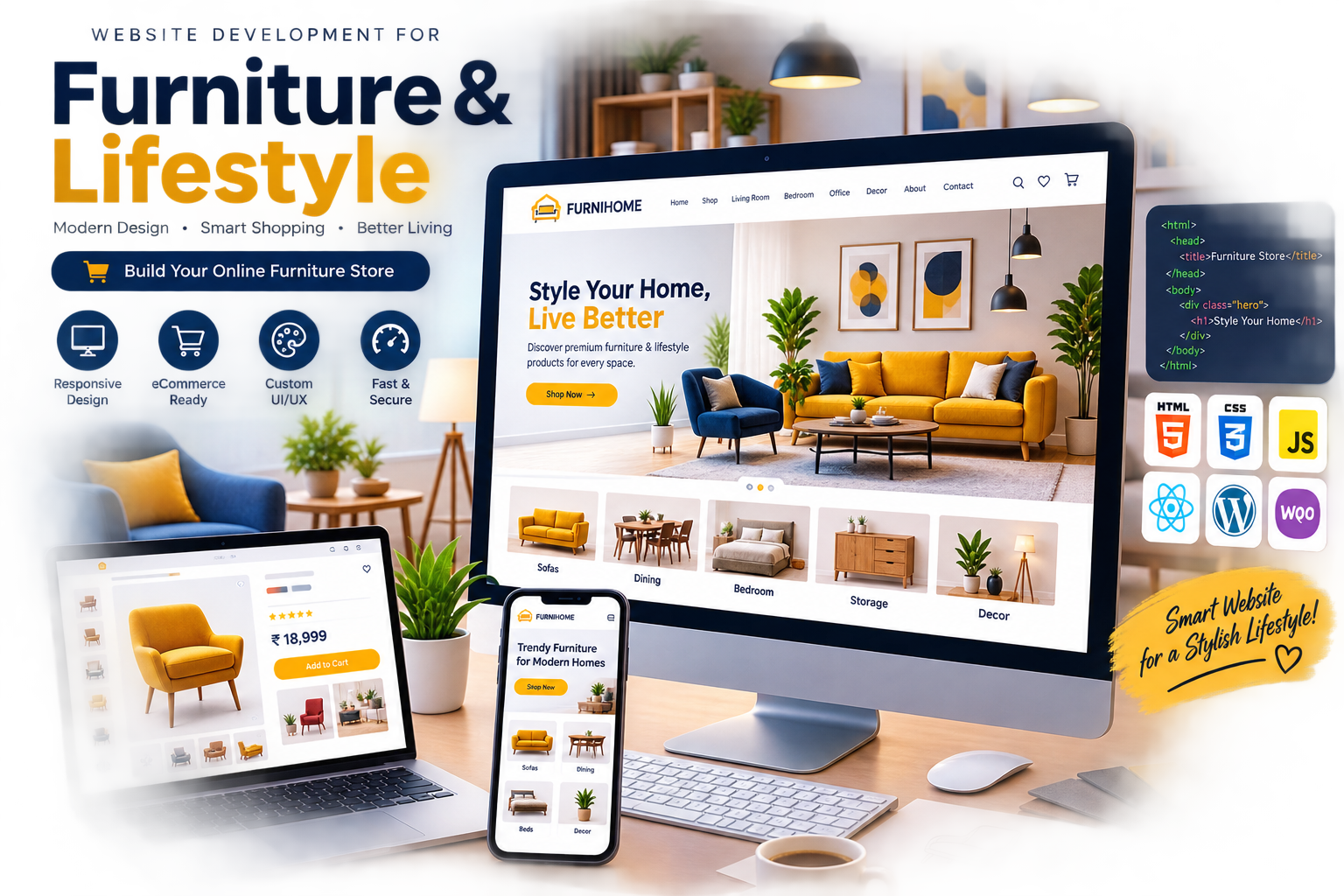
Furniture stores may need product galleries, dimensions, materials, finishes, colour options, delivery information, and enquiry functionality for customized products.
For manufacturers and bulk suppliers, the store may also include quotation requests, trade customer accounts, or project-based product enquiries, depending on the business model.
Custom eCommerce for Fashion Brands
Fashion stores may require size and colour variations, product collections, filters, wish lists, promotional pricing, and inventory tracking across variants.
Custom eCommerce for Electronics Businesses
Electronics stores may benefit from detailed specifications, product comparisons, model variations, warranty information, and compatibility details.
Custom eCommerce for Manufacturers and Wholesalers
Manufacturers and wholesalers may need bulk ordering, customer-specific pricing, quotation workflows, minimum order quantities, business account approvals, and sales team coordination.
These functions should be designed around the actual sales process and supported by the chosen technology.
Custom Shopping Cart and Checkout Development
The shopping cart and checkout are important parts of the online purchasing journey. Customization can help businesses align the purchase process with their product types, delivery rules, and customer requirements.
Potential features include:
- Cart quantity and product updates
- Product variation selection
- Guest and registered customer checkout
- Address and delivery details
- Shipping method selection
- Discount and coupon rules
- Tax and order summary display
- Payment status updates
- Order confirmation notifications
- Customized checkout fields
Checkout customization should be tested across relevant devices and payment scenarios. The implementation must also account for validation, error handling, security, and platform limitations.
Payment Gateway Integration for Custom eCommerce
An online store may need to accept digital payments through a compatible payment gateway. Available payment methods depend on the provider, merchant eligibility, platform compatibility, and account configuration.
Depending on the selected provider, integration may support UPI, debit and credit cards, net banking, digital wallets, or other supported methods.
A payment integration project may include:
- Gateway configuration
- Payment initiation and response handling
- Order status synchronization
- Failed transaction handling
- Payment confirmation notifications
- Refund workflow support where available
- Transaction records and reconciliation requirements
Payment provider approval and transaction processing remain subject to the provider\'s policies and technical requirements.
Custom Inventory and Order Management
Businesses that sell through multiple channels may need to synchronize product quantities, customer orders, and fulfilment information.
Depending on the business requirements, custom eCommerce functionality can include:
- Product SKU management
- Stock quantity tracking
- Product variation inventory
- Order status management
- Warehouse or location-based stock
- Low-stock notifications
- Purchase and replenishment workflows
- Shipping status updates
- Returns and cancellation workflows
- Sales and inventory reports
For businesses using an existing ERP, inventory application, or point-of-sale system, integration feasibility should be assessed before development begins.
B2B and Wholesale eCommerce Development
B2B commerce often requires purchasing workflows that differ from standard retail shopping. Business customers may need negotiated prices, bulk ordering, quotation requests, and account-specific purchasing options.
Depending on the scope, a B2B eCommerce solution may include:
- Business registration and account approval
- Customer-specific pricing
- Bulk order forms
- Minimum order quantities
- Tiered quantity pricing
- Quote request functionality
- Repeat order workflows
- Business account dashboards
- Invoice and payment term records
- Sales team administration
The system should be designed around the company\'s commercial policies and the capabilities of the selected platform.
Custom eCommerce API Integration
API integrations can connect an online store with other business applications and external services. They may reduce repetitive data entry and help maintain consistent information across systems.
Potential integrations include:
- CRM and customer management systems
- ERP and inventory software
- Accounting applications
- Payment gateways
- Shipping and logistics services
- Product information systems
- Email and notification platforms
- Marketplace services
- Reporting and analytics tools
Each integration requires a technical assessment covering API access, authentication, data formats, usage limits, licensing, and error-handling requirements.
Custom eCommerce Using WooCommerce or Shopify
A custom eCommerce project does not always require building every component from scratch. Existing platforms can provide core commerce functionality while allowing selected areas to be customized.
WooCommerce Customization
WooCommerce may suit businesses that prefer WordPress-based content management and want to extend their store with custom themes, plugins, integrations, or checkout functionality.
Possible work includes custom product layouts, tailored shopping workflows, compatible payment integrations, inventory features, and administrative improvements.
Shopify Customization
Shopify may suit businesses that prefer a hosted commerce platform with built-in store management features. Customization may involve theme development, storefront configuration, supported applications, and compatible integrations.
Platform limitations, subscription fees, third-party application charges, and customization options should be reviewed before selecting an approach.
Bespoke eCommerce Development
A bespoke application may be considered when specialized business workflows or technical requirements cannot be handled appropriately by available platforms.
This approach generally requires more detailed planning for architecture, security, administration, maintenance, hosting, and future upgrades.
Mobile-Friendly Custom eCommerce Websites
Customers may browse and purchase products using smartphones, tablets, and desktop computers. A responsive online store should adapt its layout to different screen sizes while keeping essential product information and checkout controls accessible.
Mobile-friendly features can include:
- Responsive product grids
- Touch-friendly navigation
- Optimized product image galleries
- Clear pricing and availability
- Mobile-friendly forms
- Readable product specifications
- Simplified cart and checkout interfaces
- Appropriate image optimization
The completed website should be tested across representative screen sizes, browsers, and purchasing workflows.
Custom eCommerce SEO and Performance
A custom online store should be structured so customers can navigate it easily and search engines can discover relevant pages.
SEO and technical planning may include:
- Search-friendly product and category URLs
- Unique page titles and meta descriptions
- Product and category content optimization
- Internal linking
- Image alt text
- XML sitemap and indexing configuration
- Canonical URL planning
- Appropriate structured data
- Mobile usability checks
- Page speed and asset optimization
Performance work may also involve caching, image compression, database optimization, and efficient application code where appropriate. Results depend on the implementation, hosting environment, product catalogue, and other technical factors.
Search rankings and sales cannot be guaranteed.
eCommerce Security and Maintenance
Online stores handle important business information and may process customer and payment-related data. Security and maintenance should be considered from the beginning of the project.
Depending on the architecture and agreed support scope, activities may include:
- Secure authentication and access controls
- Input validation and error handling
- Software and dependency updates
- Backup and recovery planning
- Monitoring and troubleshooting
- Payment integration checks
- Administrative access reviews
- Performance maintenance
- Compatibility testing
Payment card data should be handled according to the selected provider\'s recommended integration model and applicable security requirements. No single measure guarantees complete security.
Our Custom eCommerce Development Process
A structured development process helps establish clear requirements and manage implementation.
1. Business Requirement Analysis
Review your product catalogue, sales workflow, target audience, customer journey, existing software, and operational needs.
2. Solution and Platform Planning
Evaluate whether a customized existing platform or bespoke development is appropriate for your requirements and budget.
3. Design and Technical Architecture
Plan storefront layouts, database requirements, integrations, user roles, checkout workflows, and administration features.
4. Development and Integration
Implement the agreed functionality and configure compatible third-party services.
5. Testing and Validation
Test product management, shopping cart behaviour, checkout, payment scenarios, responsive layouts, and required integrations.
6. Deployment and Launch
Prepare the hosting environment, configure production settings, review backups, and complete agreed launch checks.
7. Post-Launch Improvements
Address agreed issues, review user feedback, and plan additional features according to business priorities.
Why Consider Whiz Technology for Custom eCommerce Development?
Selecting an eCommerce development partner involves assessing technical capability, communication, project planning, and long-term support.
Whiz Technology can help businesses define custom eCommerce requirements and evaluate suitable implementation options. Depending on the project, services may include:
- Custom storefront design
- eCommerce platform customization
- Product catalogue development
- Checkout and payment integration
- B2B and wholesale functionality planning
- Inventory and business system integrations
- Technical SEO foundations
- Deployment and maintenance options
Before starting a project, confirm the functionality, deliverables, timeline, hosting requirements, third-party costs, source-code ownership, testing process, and support arrangements.
Custom eCommerce Development Across Delhi NCR
Businesses in Delhi NCR may have different requirements depending on their products, sales channels, customer base, and fulfilment operations.
Custom eCommerce projects can be discussed for eligible businesses serving Delhi, Noida, Gurugram, Ghaziabad, Faridabad, and nearby areas. The recommended implementation should be based on the business\'s operational requirements and technical needs.
Frequently Asked Questions
1. What is custom eCommerce development?
Custom eCommerce development involves building or modifying an online store to support specific product, checkout, inventory, integration, and business workflow requirements.
2. How much does custom eCommerce development cost in Delhi?
Pricing depends on the number of features, platform choice, custom workflows, integrations, product catalogue, security requirements, and maintenance needs. An estimate should follow a requirements assessment.
3. Is custom eCommerce better than a standard online store?
Custom development may be useful when a business needs functionality that standard features cannot adequately support. A standard platform may be more suitable when its existing features meet the requirements with less complexity.
4. Can you customize WooCommerce or Shopify?
Customization may be possible within the capabilities, APIs, extension systems, and policies of the selected platform. Feasibility should be checked before committing to specific functionality.
5. Can you develop a B2B eCommerce website?
A B2B store can be planned around requirements such as bulk ordering, quotation requests, approved business accounts, and customer-specific pricing where supported by the chosen implementation.
6. Can a custom store connect with my ERP or inventory software?
Integration may be possible if the existing system provides suitable APIs or other supported data exchange methods. The technical requirements and limitations should be assessed first.
7. Will the website be mobile-friendly and SEO-ready?
The project can include responsive design and technical SEO foundations such as metadata, crawlable navigation, suitable URLs, and indexing configuration. Ongoing SEO and testing may be needed after launch.
8. Do you provide maintenance after launch?
Maintenance can be included through a separate or project-specific support arrangement. The scope should define updates, backups, troubleshooting, response times, and any additional fees.
Start Your Custom eCommerce Project in Delhi
Looking for custom eCommerce development in Delhi? Contact Whiz Technology to discuss your online store, business workflows, product catalogue, required integrations, and long-term objectives.
Company: Whiz Technology
Website: https://whiztechnology.in/
Email: info.whiztechnology@gmail.com
Share your business type, approximate number of products, preferred platform, and the custom features you need to help define a practical project scope.
Features, integrations, costs, timelines, and support depend on the agreed requirements and technical feasibility. Search rankings, sales, and other commercial outcomes are not guaranteed.